What Is Draping in Fashion Design? A Beginner’s Guide
Draping is the practice of shaping fabric directly on a dress form to develop a garment, rather than drafting it flat on paper first. It is how a lot of original shapes are found, and it is the fastest way to see whether a fabric will actually do what you imagined.
Draping, defined
You pin a length of fabric onto a dress form, manipulate it into folds, tucks or volume, and mark the seam lines you discover. Those marks are then transferred to paper to make a pattern. The form is the body; the fabric is the medium; the pattern is the record.
The word is also used loosely for "how fabric hangs", as in "this silk has beautiful drape". Both uses are common. In a workroom, draping means the technique.
Draping vs pattern making
| Draping | Flat pattern making | |
|---|---|---|
| Works on | A three-dimensional form | Paper |
| Best for | New shapes, unusual volume, bias work | Repeatable basics, grading, production |
| Fabric behaviour | Visible immediately | Predicted from experience |
| Speed | Fast to explore, slower to formalise | Slow to start, fast to reproduce |
| Fabric needed | More (you cut generously) | Less |
They are not rivals. A common professional loop is: drape to find the shape, transfer to paper, then use flat pattern making to refine, grade and reproduce it.
Why the dress form is central
Without a form you cannot see how cloth falls around a bust, over a shoulder or into a hip. Pinning fabric to a table gives you a flat arrangement, which is a different problem. The form also lets you work at eye level and step back to judge proportion, which is where most design decisions are actually made.
If you do not own one, the types of dress forms guide explains which shape suits draping. A half body form is enough to start.
Choosing fabric for draping
Start with muslin or calico. It is stable, takes chalk, holds a pin and does not fight you. Only once the shape is right should you test in the final fabric, because the final fabric will change the result — sometimes completely.
- Stable wovens hold folds and are easiest to control.
- Bias-cut fabric stretches and drops; let it hang before marking.
- Sheer fabrics slip and show every pin; use fine pins and tissue paper.
- Knits stretch under their own weight; pin with less tension than you think.
A basic draping workflow
- Prepare the form. Mark the centre front, centre back, bust, waist and hip lines with narrow tape. These are your reference lines for the whole session.
- Prepare the fabric. Block and steam it so the grain is straight, then mark the grainline and centre front on the cloth.
- Pin the anchor points. Centre front at the neckline, bust point, waist. Anchor first, shape second.
- Shape gradually. Work from the anchor outward, smoothing and pinning in small increments. Do not pull the fabric into place; let it fall.
- Mark the design lines. Chalk or pin-mark the seams, darts and edges directly on the fabric while it is still on the form.
- True the lines. Take the piece off, lay it flat and straighten the marked lines with a ruler before transferring to paper.
- Transfer to pattern paper. Add seam allowance and grainline, then sew a toile to test it.
Common beginner mistakes
- Pulling instead of letting go. Tension in the fabric becomes distortion in the garment.
- Too many pins, too early. Pin the anchors, then shape; pinning everything at once locks in the first idea.
- Skipping the reference tape. Without centre and waist lines, the drape drifts and cannot be reproduced.
- Draping only in the final fabric. Expensive and hard to control. Muslin first.
- Not making a toile. The drape is not a pattern until it has been tested as a sewn garment.
Marking tools worth owning
Chalk, pencils and pins that transfer your pattern onto cloth.
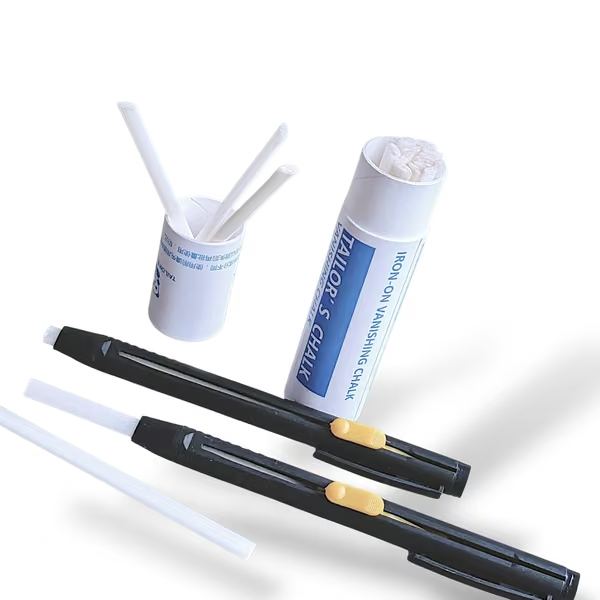
Marking tools
Vanishing fabric marker pen set, 2 pens + 20 refills (opens on Amazon in a new tab)
Chisel-tip chalk pens that mark cloth and fade instead of staining it.
- Chisel tip draws fine lines or broad marks
- Refills keep the set working for longer
Best for: Transferring darts, seam lines and hems onto fabric.
Check price for Vanishing fabric marker pen set, 2 pens + 20 refills (opens in a new tab)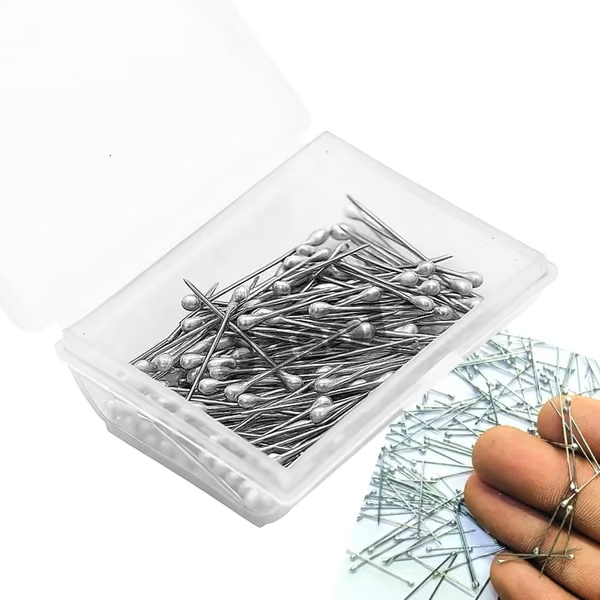
Marking tools
Sewing head pins, 2.5 cm, pack of 300 (opens on Amazon in a new tab)
A bulk box of stainless steel pins that will not rust in storage.
- 300 pins in a reusable plastic box
- Fine shafts suit lightweight fabric
Best for: Pinning pattern pieces and fitting on a dress form.
Check price for Sewing head pins, 2.5 cm, pack of 300 (opens in a new tab)How to learn it at home
Start with a simple bodice front: anchor the centre line, smooth the fabric over the bust, pin the shoulder and side seam, and mark the darts you had to create. Do it five times. The fifth attempt will look dramatically different from the first.
Then try a cowl neckline or a bias skirt — both are shapes that are much easier to find by draping than by drafting. Keep your toiles; they are your progress record.
Next steps
If you are new to the studio, read how to start fashion designing at home, and check the dress form guide before buying your first form.
Frequently asked questions
Do I need a dress form to drape?
Yes. Draping is defined by working on a three-dimensional body; a table cannot substitute. A basic half body form with a pinnable cover is enough to learn on.
Is draping better than pattern making?
Neither is better. Draping is faster for experimental shapes and for seeing how a specific fabric behaves. Pattern making is faster for repeatable, graded production. Most designers use both.
What fabric should a beginner drape with?
A medium-weight cotton muslin or calico. It is stable, cheap and easy to mark. Once the shape is right, drape again in the final fabric to check how it really behaves.