How to Start Fashion Designing at Home: Tools, Techniques and Basics
Fashion design at home fails for a boring reason: people try to learn sketching, pattern making, draping, sewing and fitting simultaneously, then conclude they have no talent. The skills stack in a rough order. Learn them in that order and progress feels much less random.
What fashion design actually involves
Design is not only drawing. A finished garment passes through at least six stages: an idea, a sketch, a measurement set, a pattern, a toile (test garment), and a fitting. Each stage catches different mistakes. Skipping stages does not save time; it moves the mistake later, where it costs more fabric.
At home you can run all six stages with a table, a sewing machine, a dress form and a small box of tools.
Sketching, at the level you need
You are not being judged on illustration. Design sketching has one job: to record a silhouette, a proportion and a detail clearly enough that you can build it later.
- Use a printed croquis (a body outline) until your freehand proportions are reliable.
- Draw the same design on three different croquis proportions to see what changes.
- Annotate: fabric, closure, seam placement, length. A sketch without notes is a mood, not a plan.
Measurements come before patterns
Every pattern starts as numbers. Learn to take a consistent set — bust, waist, hip, shoulder, back length — and to record the unit and date. If you sew for other people, keep a card per person.
The measurement guide covers technique and the mistakes that quietly shift every number.
Understanding fabric
Fabric choice changes a design more than most beginners expect. A shape that works in crisp cotton may collapse in viscose. Learn four properties and you can predict most behaviour:
- Drape: how readily it falls into folds.
- Body: how much it holds its own shape.
- Stretch: whether it returns to shape after pulling.
- Weight: how it hangs under its own mass.
Before cutting into good cloth, drape a metre of it over a dress form or your arm and look at it. Ten seconds of looking prevents a lot of regret.
Pattern making
Flat pattern making means drafting a two-dimensional template that, when sewn, becomes a three-dimensional garment. Start with a basic block — a simple bodice or skirt drafted to your measurements — and adapt it. Blocks are the foundation of nearly everything else.
You need pattern paper, a set square, a French curve and a pencil. The first block will be wrong; the second will be less wrong. This is normal.
Draping
Draping develops a shape directly on a dress form, in fabric, and then transfers it to paper. It is faster for experimental shapes and slower for repeatable production. Most designers use both, choosing per garment. The beginner’s guide to draping explains the workflow step by step.
Sewing
You need enough machine skill to sew a straight seam, a curve, a dart and a zip. That is a weekend of practice, not a course. Learn to press as you sew; it is the cheapest quality upgrade available.
Garment fitting
A toile is a test garment in cheap fabric, made from your pattern. Fit it, mark corrections, transfer them to the paper, and only then cut the final fabric. This single habit separates work that fits from work that nearly fits. Our fitting problems guide is the diagnostic reference.
A 90-day starting roadmap
| Weeks | Focus | Deliverable |
|---|---|---|
| 1–2 | Measurements, tools, machine basics | A measurement card and five straight seams you would wear |
| 3–4 | Commercial pattern, simple skirt | One finished skirt, pressed |
| 5–6 | Drafting a basic block | A bodice block that matches your measurements |
| 7–8 | Toile and fitting | A corrected block plus a list of what you changed |
| 9–10 | Draping basics | One draped detail transferred to paper |
| 11–12 | Small collection | Two garments from your own patterns |
Adjust the pace, keep the order.
Pattern making worth owning
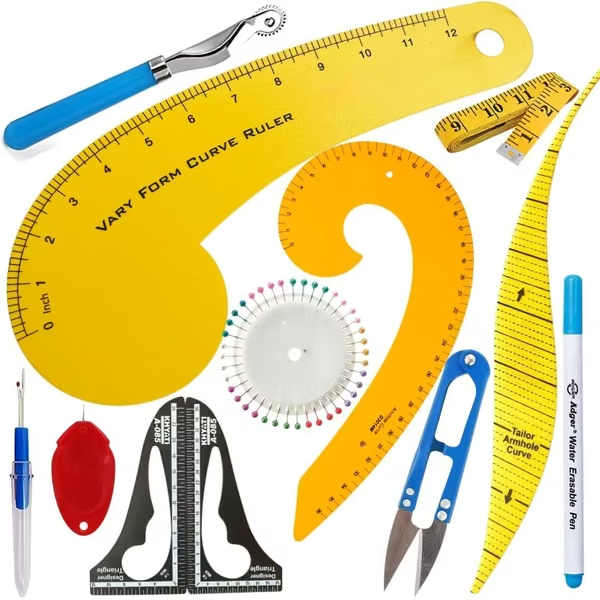
Curves, rulers and sets for drafting flat patterns.
Pattern making
12-piece pattern-making and tailoring kit (opens on Amazon in a new tab)
French curve, armhole ruler and tape for drafting and adapting patterns.
- Curves cover armholes, necklines and hips
- Everything needed for a flat pattern in one box
Best for: Drafting blocks and adapting patterns to a body.
Check price for 12-piece pattern-making and tailoring kit (opens in a new tab)Next steps
Assemble the essential tools first, then decide whether you need a dress form for draping and fitting.
Frequently asked questions
Do I need a design degree to start?
No. A degree helps with networks and structured critique, but the core skills — measuring, drafting, sewing, fitting — are learned by making garments. What you need is a method and someone honest to look at the results.
Which comes first, sketching or sewing?
Both, in small amounts. Sketch to develop ideas, sew to learn what fabric actually does. Designers who cannot sew tend to make unbuildable drawings; sewers who cannot sketch struggle to develop original work.
How long does it take to make a first garment?
A simple skirt or top from a commercial pattern is a weekend project for a beginner. A fitted bodice with a toile and two fittings takes considerably longer. Expect the first attempt to be a learning piece rather than a wardrobe item.